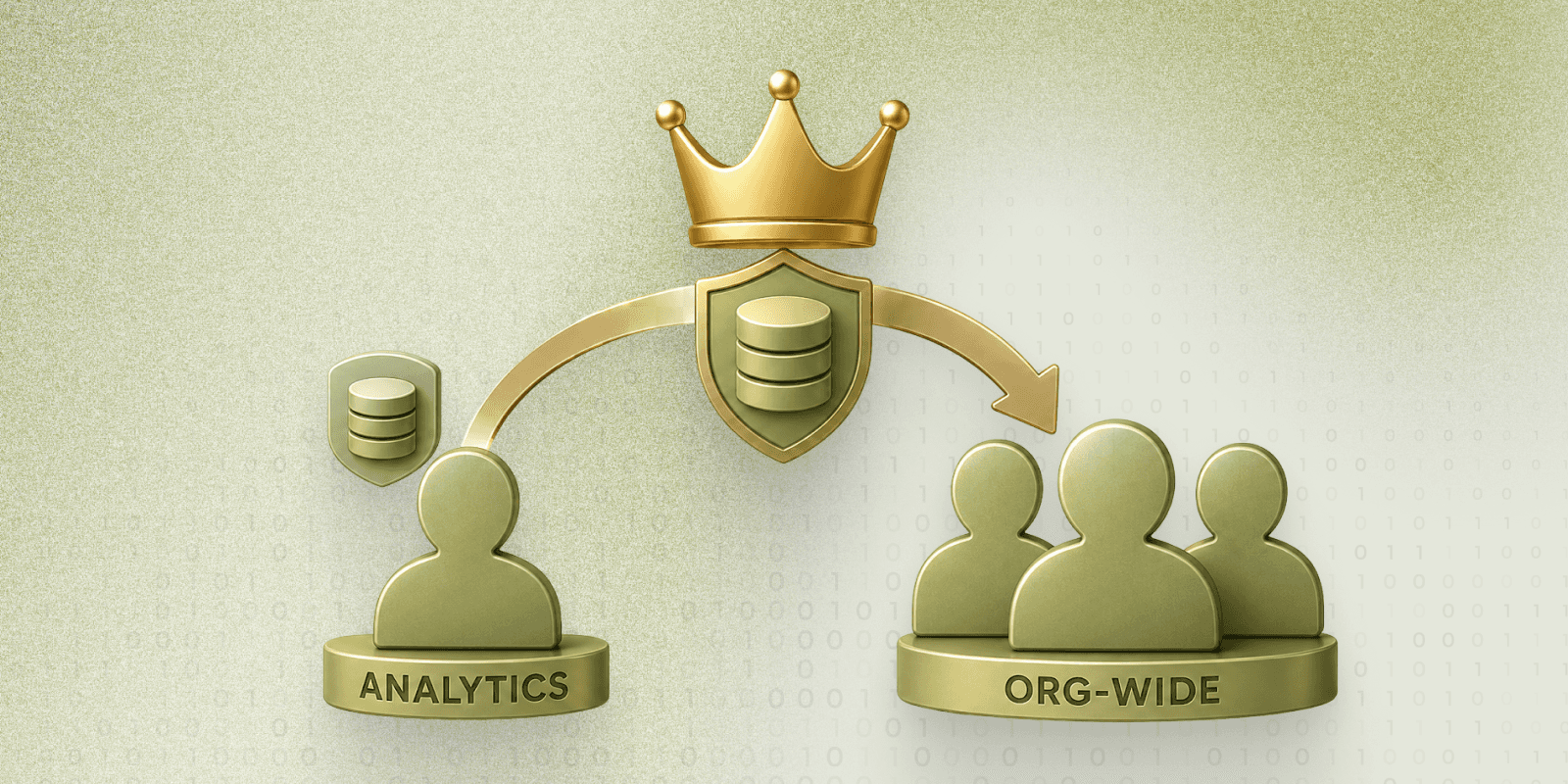
Ask ten leaders at a mid-to-large company who owns the data layer, and eight of them will point to the analytics team. That answer used to make sense. It doesn't anymore.
For years, "owning the data layer" meant owning the queries. The analytics team built the dashboards, wrote the SQL, and stood between raw data and every decision that depended on it. That made them the bottleneck by design — not because they were slow, but because the architecture routed every question through one team's inbox.
Now that AI assistants can answer natural-language questions directly against a company's own data, that architecture is breaking down. The question isn't "who writes the queries" anymore. It's "who's accountable for the data being right, secure, and usable when a machine — not a human analyst — is the one answering." That's a different job, and it can't sit with the analytics team alone.
In this article, we'll break down why data ownership needs to shift, what it actually means to own the data layer in an AI-assisted enterprise, and who should be holding the pieces.
What "Owning the Data Layer" Used to Mean
Traditionally, data layer ownership was really query ownership. The analytics team maintained the pipelines, wrote the reports, and gatekept access — partly for good reason: raw data is messy, inconsistent, and easy to misinterpret without context.
That model worked when the volume of questions was manageable and the only way to get an answer was to ask someone who knew SQL. A finance lead who wanted a same-day forecast filed a ticket and waited. The analytics team wasn't hoarding power — they were the only interface the data had.
Why This Is Costing Your Team
The cost of that model shows up as delay, not dysfunction. Decisions stall while requests sit in a queue. Analysts spend their time running repeat queries instead of doing the analysis that actually needs a human, and when an AI assistant enters the picture and starts answering questions directly, the analytics team is still the default owner of a layer they no longer fully control.
That's the real risk: not that AI removes the analytics team's role, but that nobody redefines it, so accountability gets fuzzy exactly when more people — and more automated systems — are touching the data than ever before.
How This Differs from a Governance Problem
It's tempting to treat this as a data governance question and stop there. It isn't just that. Governance is about rules — who's allowed to see what. Ownership is about accountability — who's responsible when the data layer itself needs to change, when access needs to be re-scoped, or when an AI assistant returns an answer that's technically correct but contextually wrong.
You can have perfect governance policies and still have no clear owner for the data layer as a living system. That gap is what shows up as confusion the first time someone asks, "Who approved the AI assistant having access to that table?"
Three Ways to Fix Data Layer Ownership
Split "data steward" from "query builder." The analytics team should still own data quality, lineage, and modeling — the things that require deep technical context. But they shouldn't be the sole approval gate for who can ask what. That's a separate, ongoing responsibility.
Make IT/security co-owners of access, not just infrastructure. Once an AI assistant can index databases, documents, and internal systems, access control stops being a one-time setup task and becomes an operational responsibility. Role-based permissions and self-hosted deployment only work if someone owns keeping them current.
Give business teams a defined lane, not just access. Self-serve doesn't mean unrestricted. Retail ops, finance, and other business teams need a clear scope of what they can ask and see — defined jointly with data and security, not bolted on after the fact.
Conclusion
The instinct to hand data layer ownership to "the analytics team" made sense when they were the only interface between raw data and a business question. Once AI assistants can answer those questions directly, that single point of ownership becomes a liability — not because analysts did anything wrong, but because the job of owning the data layer has split into pieces: quality and modeling, access and security, and business-team scope.
Oriona was built for exactly this shift. It connects to your existing databases, documents, and systems, indexes them securely, and enforces role-based access so business teams get direct, cited answers — without turning every question into an ownership dispute. Self-hosted deployment means IT and security stay in control of who can access what, while the analytics team gets to focus on the data problems that actually need their expertise.